Keep Your Powder Dry
Keep Your Powder Dry
Previously a two part loose article from 2014
 |
| Click to enlarge |
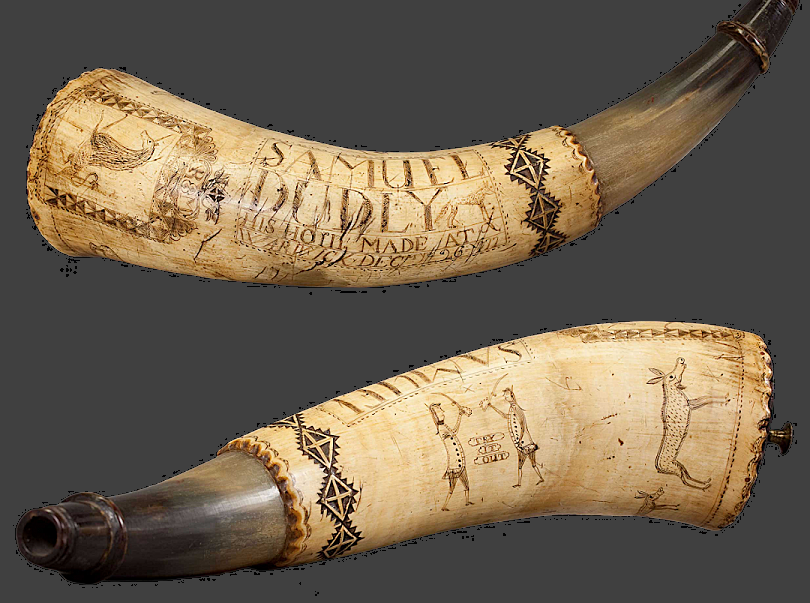
This is a Revolutionary War powder-horn featuring some great scrimshaw and was recently up for sale in Portsmouth, UK. This is reportedly from a soldier who served in the British 7th Regiment of Foot and “features a map of the Hudson River, the famous river that flows from north to south through eastern New York State, as it was during the American revolution… The profuse engravings include depictions of wildlife (including a beaver and deer), the towns (Saratoga, Stonrabby), states (Albany), forts (Fort Hunter, Fort Henry) & tributaries (Mohawk River, North River) as they were during this era. Also depicted on this is a view of New York city, with ships underneath for the ocean that lays beyond. The British Royal coat of arms lays on the larger, lower edge. The owner is named in a cartouche..."W.M.Gill, His horn press on"
Engraving of personal items can be viewed as common overall during this era, much like any time of war, and oft is deemed by a more contemporary term of “trench art” when applied to relics like this. Powder-horns are notable as they tend to lend graphic representation of a soldiers service, or at least the geographic region in which they were deployed.
Something can be said as well by the comparison of artists’ works over time, as to the conditions or strategic locations – especially when applied to frontier New York. For example, below is a sketch created from another powder-horn that also bore a representation of Ft. Hunter – this time from a much earlier year and previously dated as 1759.
 |
| Source: American Engraved Powder Horns, by Stephen V. Granesay, Ray Riling Arms Books Co., Phildelphia, 1965 |
It should be noted that powder horns were used to store bulk powder despite what Hollywood misrepresents. No foolhardy musketeer would think of pouring a cask of powder into their barrel, especially during sustained firing! Most people are too attached to their hands and faces to attempt such dangerous loading practices.
We have briefly explored the artistic aspects of powder horns and how they portrayed the Fort Hunter area in the colonial era. A small disclaimer above mentions that horns were used to store bulk powder. So, let's take a quick look at that concept of bulk powder as it translates to ammunition cartridges and use.
 A 2014 post on Journal of the American Revolution covered severe supply shortages in powder the army needed to be an effective fighting force; especially early in the war before heavy foreign support. Commentary on that post by scholars and authors does a great job in demonstrating bulk powder stored in barrels and how that translates into rounds of ammunition per pound and per soldier. For each round the dry weight measurement of grains is used, and the number of approximate grains per pound averages at seven thousand. There is some uncertainty as to the number of pounds per barrel but the common accepted number of rounds that could be produced from it is around 3,500. That roughly indicates an average of 40 rounds per pound, assuming that the barrel contains about 90lbs of powder. Each round would contain somewhere over 160gr to 220gr that was typically to be used to propel a .69-cal ball from a .75cal musket.
The math can seem overwhelmingly insecure – especially when we are working with rough ideas and the adjustment of measurement scales that may skew figures. But that all seems a bit beside the point here.
How was this powder keep secure and dry – or at least as much as possible given circumstances? The answer to that has some variations as well, however we will take a short journey through common practices.
 |
| Image sourced: NPA.gov |
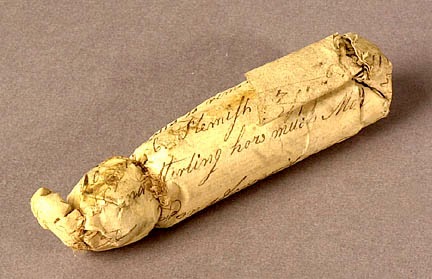
Most notably is the standardization of rounds into cartridges that could be created with a treated paper. These cartridges served the purpose of powder protection, and almost more importantly consistency for each shot and reduction of loading time. As show in the image, a paper cartridge would be rolled around a dowel and ball. With the ball end folded and securely affixed to keep the end tight and now allow loose grain powder to spill out, the dowel was then removed and the paper tube would be filled with a measured amount of powder. The open end would be folded and secured leaving a “flap” that would be used to open the cartridge for loading.
 |
| Image sourced: NWTA.com |
Paper cartridges were often coated in beeswax, lard, or tallow, which served a number of purposes. It provided some degree of water resistance, it lubricated the paper-wrapped bullet as it was pushed down the bore, and it melted upon firing to mix with the powder residue and make the resulting fouling easier to remove.
So now what? The cartridges would further be protected after being made or distributed to individual soldiers by use of a cartridge box. More on that in a future post....

_______________________
As always, your comments and or questions are encouraged!


Comments
Post a Comment